NAACL 2025 FindingsDocument design for RAG
Evaluating Self-Generated Documents for Enhancing Retrieval-Augmented Generation with Large Language Models
Documents generated by a model can help retrieval-augmented answers, but their usefulness depends on document style, model capacity, and how they are combined with retrieved evidence.
- Result
- CCU documents plus style-transformed Wikipedia average 53.6 (EM/F1, Qwen2.5-32B), vs 52.1 for GenRead Direct Mix and 45.6 for Wikipedia alone.
- New vs prior
- GenRead (Yu et al., 2023) generates background documents instead of retrieving them; this work asks which document types and mixing strategies help.
- Limitation
- Human evaluation checks only style adherence; the authors note that the factual accuracy of self-generated documents cannot be guaranteed.
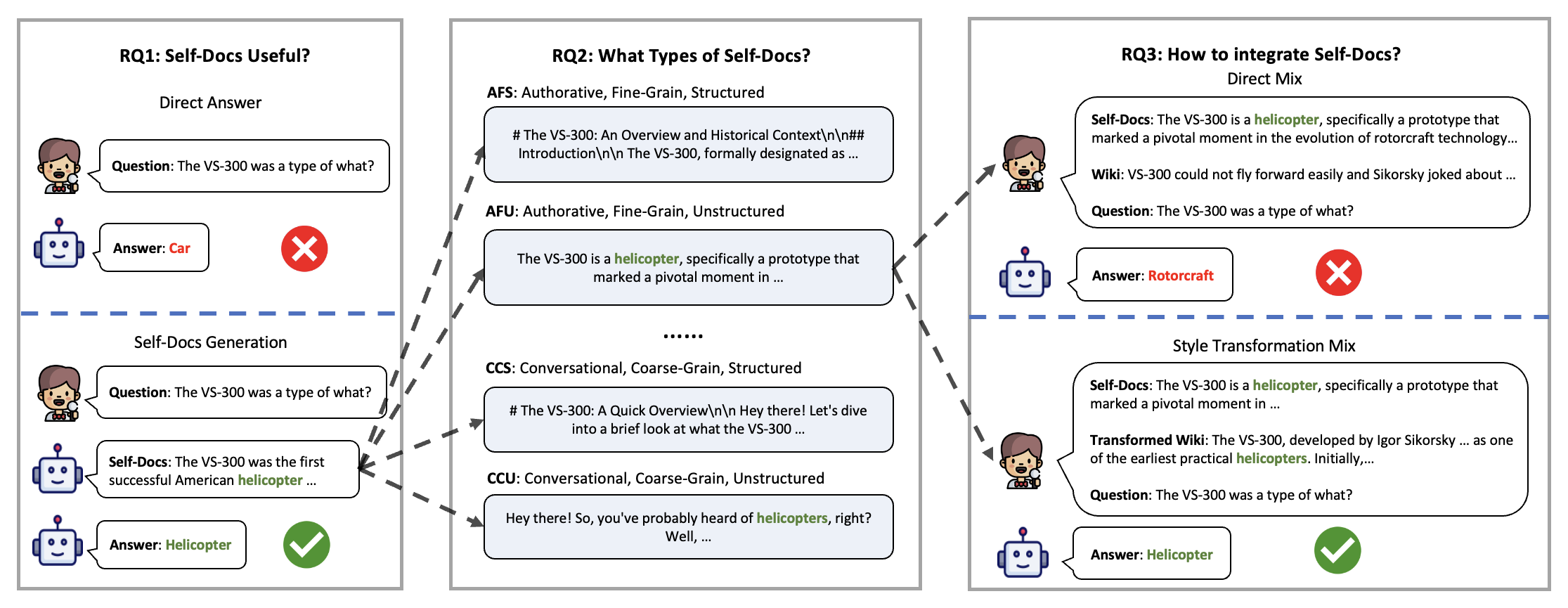
Generated context is a representation choice
Self-generated documents (Self-Docs) are passages a model writes from its own parametric memory before answering. They draw on no external source; they externalize what the generator can already produce, which may make useful facts easier to use. If the source is generated rather than retrieved, which properties of that text decide whether it helps?
The paper treats the document type as an experimental variable. A detailed formal report and a conversational overview can share facts yet suit different tasks: fact verification needs specific evidence, while a long-form explanation needs coverage and organization.
Closest prior work
Generation-augmented methods such as GenRead (Yu et al., 2023) and recitation-augmented models (Sun et al., 2023) have a model write background passages before answering, and hybrid approaches (Zhang et al., 2023; Abdallah and Jatowt, 2024) merge generated with retrieved documents. The paper notes that this work has mostly focused on how to use such documents, for example how to handle conflicting knowledge, while overlooking how different types of generated documents affect performance. It therefore classifies Self-Docs with a Systemic Functional Linguistics taxonomy and reuses GenRead's pipeline as its generator.
Style-aligned mixing helps, except on long-form answers
53.6 vs 52.1
Average score: CCU + style-transformed Wikipedia vs GenRead Direct Mix
Qwen2.5-32B-Instruct; mean of EM (TQA, FEVER) and F1 (HotpotQA, ELI5). Wikipedia passages alone average 45.6.
26.7 vs 26.5
ELI5 F1: Wikipedia alone vs best mix
On long-form QA, retrieved Wikipedia passages alone remain best; no self-generated document type or mixing strategy surpasses them.
Measured · Tables 2, 10 and 12 · examples from Figure 1 and Appendix G.2
Which document type helps which task?
Choose a tone, a granularity, and a structure to select one of the eight Self-Doc types, then choose whether the documents are used alone or mixed with Wikipedia passages. All eight types stay in the table; the second table changes one choice at a time.
Selected type
AFU Table 4 example: Case Studies
- Authoritative (Interpersonal metafunction): a formal style that establishes authority, as in a research paper.
- Fine-grained (Ideational metafunction): detailed information, as in a technical paper.
- Unstructured (Textual metafunction): continuous prose with a narrative flow, as in an essay.
Question (TQA): The VS-300 was a type of what?
The VS-300 is a helicopter, specifically a prototype that marked a pivotal moment in the evolution of rotorcraft technology during the early 1940s. …
Scores of all eight types: Self-Docs alone (Table 2)
| Type | TQAEM | HotpotQAF1 | FEVEREM | ELI5F1 | Averagemean |
|---|---|---|---|---|---|
| AFSResearch Paper | 55.4 | 37.5 | 83.4 | 20.9 | 49.3 |
| AFUCase Studies | 58.4 | 39.9 | 85.2 | 22.8 | 51.6 |
| ACSNews Article | 56.8 | 38.7 | 83.6 | 22.0 | 50.3 |
| ACUOpinion Pieces | 56.4 | 39.6 | 85.0 | 23.5 | 51.1 |
| CFSHow-to Guides | 57.4 | 36.4 | 81.8 | 24.0 | 49.9 |
| CFUPersonal Essays | 57.8 | 39.5 | 84.2 | 25.1 | 51.6 |
| CCSTravel Blogs | 56.0 | 35.2 | 82.0 | 25.4 | 49.6 |
| CCUSocial Media Posts | 56.6 | 38.7 | 83.8 | 26.4 | 51.4 |
| WikiWikipedia passages alone | 52.6 | 36.3 | 66.8 | 26.7 | 45.6 |
| GenRead mixGenRead documents, Direct Mix | 57.6 | 39.1 | 87.0 | 24.7 | 52.1 |
EM for TQA and FEVER, F1 for HotpotQA and ELI5; Qwen2.5-32B-Instruct answers the first 500 examples of each dataset. The best Self-Doc score in each column is bold. In the mixed conditions, small figures are the printed changes from the same type alone (Table 2).
Change one choice of AFU
| Advantage | TQA | HotpotQA | FEVER | ELI5 | Average |
|---|---|---|---|---|---|
| Authoritative over conversationalAFU vs CFU | +0.62/4 pairs | +0.44/4 pairs | +1.04/4 pairs | −2.30/4 pairs | 0.01/4 pairs |
| Fine-grained over coarse-grainedAFU vs ACU | +2.03/4 pairs | +0.33/4 pairs | +0.22/4 pairs | −0.70/4 pairs | +0.53/4 pairs |
| Unstructured over structuredAFU vs AFS | +3.03/4 pairs | +2.44/4 pairs | +1.84/4 pairs | +1.94/4 pairs | +2.34/4 pairs |
Each cell is the selected type's score minus the type that differs in one choice. “n/4 pairs” counts, over all four type pairs that differ only in that choice, how often the selected choice scores higher, so a pattern can be checked beyond this one pair.
Selected type
AFU (authoritative, fine-grained, unstructured), Self-Docs alone (Table 2): TQA 58.4 (rank 1 of 8); HotpotQA 39.9 (rank 1 of 8); FEVER 85.2 (rank 1 of 8); ELI5 22.8 (rank 6 of 8); Average 51.6 (rank 1 of 8, tied with CFU). Wikipedia passages alone score higher on ELI5.
Measured: Table 2 (Self-Docs alone), Table 10 (with Wikipedia, Direct Mix), and Table 12 (with Wikipedia, Style-Transformation Mix), NAACL 2025 Findings; the page's results table repeats three rows of each mix (Table 5). Types and examples: Section 5.1 and Table 4; document openings from Figure 1 and Appendix G.2, shortened. Comparisons are computed here from the per-type rows.
Gains are task-specific. Relative to the same documents alone, Style-Transformation Mix gains most on multi-hop HotpotQA and fact-verification FEVER and leaves long-form ELI5 essentially unchanged. Among generated types, unstructured documents beat structured ones on average, authoritative fine-grained ones suit FEVER, and conversational ones suit ELI5.
Scale effects are also uneven. A larger generator helps only above a size threshold; smaller generators struggle to beat either answering without documents or Wikipedia retrieval. More documents help FEVER, while ELI5 may plateau or dip.
Scope. Main experiments use Qwen2.5-32B-Instruct and 500 examples per task across four datasets. Generated documents can contain factual errors, and effective styles vary with task and model. Read the study ↗
Read the abstract
The integration of documents generated by LLMs themselves (Self-Docs) alongside retrieved documents has emerged as a promising strategy for retrieval-augmented generation systems. However, previous research primarily focuses on optimizing the use of Self-Docs, with their inherent properties remaining underexplored. To bridge this gap, we first investigate the overall effectiveness of Self-Docs, identifying key factors that shape their contribution to RAG performance (RQ1). Building on these insights, we develop a taxonomy grounded in Systemic Functional Linguistics to compare the influence of various Self-Docs categories (RQ2) and explore strategies for combining them with external sources (RQ3). Our findings reveal which types of Self-Docs are most beneficial and offer practical guidelines for leveraging them to achieve significant improvements in knowledge-intensive question answering tasks.
Full paper ↗Citation BibTeX
@inproceedings{li-etal-2025-evaluating,
    title = {Evaluating Self-Generated Documents for Enhancing Retrieval-Augmented Generation with Large Language Models},
    author = {Li, Jiatao and Hu, Xinyu and Yin, Xunjian and Wan, Xiaojun},
    booktitle = {Findings of the Association for Computational Linguistics: NAACL 2025},
    year = {2025},
    url = {https://aclanthology.org/2025.findings-naacl.149/},
    doi = {10.18653/v1/2025.findings-naacl.149},
    pages = {2741--2775}
}