ICLR 2026Representation geometry
The Geometry of Reasoning: Flowing Logics in Representation Space
When the same logical argument is expressed across topics and languages, changes along its representation trajectory reveal more shared logical structure than embedding positions alone.
- Result
- For Qwen3-0.6B, curvature similarity is 0.53 between flows sharing logic vs 0.13 between flows sharing language; position similarity reverses the order (0.26 vs 0.85).
- New vs prior
- The Linear Representation Hypothesis treats concepts as linear directions, and graph views treat chain-of-thought as discrete nodes; this work models reasoning as a continuous flow with velocity and curvature.
- Limitation
- The study analyzes understanding rather than generation, so the paper does not relate its geometric measures to the accuracy of model outputs.
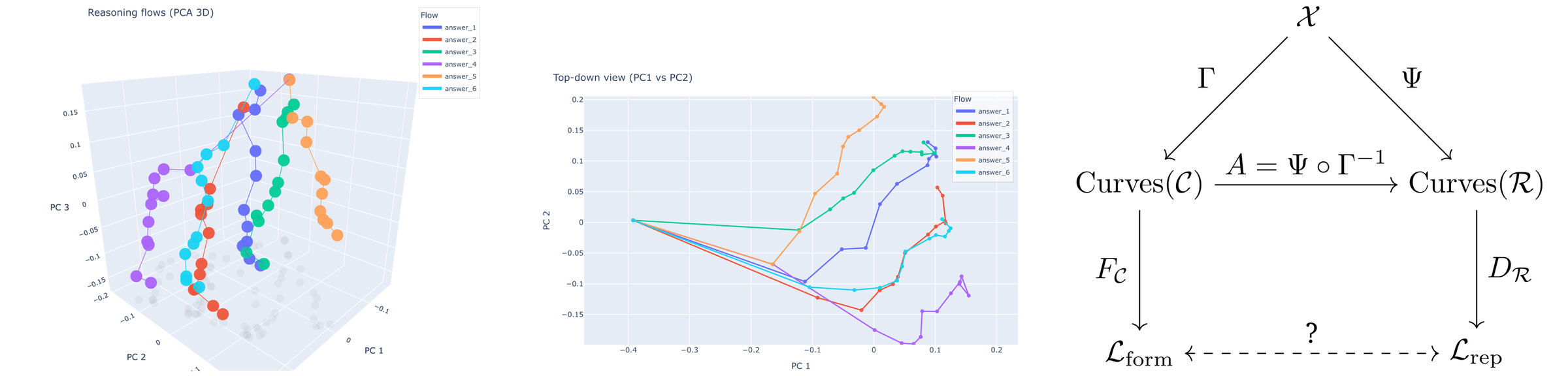
Similar meanings can obscure similar reasoning
An argument’s representation mixes topic, language, entities and logical structure. Two English passages about weather can sit close together even when their deductions differ, while one deduction in two languages can sit far apart, so comparing isolated embeddings risks measuring surface content.
Take “If it rains, the ground is wet; it rains; therefore the ground is wet.” Replacing weather with servers (“If a server is overloaded, latency rises; …”) changes the concepts but keeps the inference. The paper applies this controlled variation to longer natural-deduction structures across topics and languages.
Closest prior work
The Linear Representation Hypothesis holds that concepts align with linear directions in embedding space, and later work finds multi-dimensional, manifold-like and compositional features. Graph-based accounts model chain-of-thought as discrete nodes (Wang et al., 2024; Minegishi et al., 2025), which the paper argues fits random walks between isolated embeddings but misses the smooth, directed dynamics under cumulative context. This work instead treats reasoning as a continuous flow and tests whether its velocity and curvature track logical structure across topics and languages.
Positions group by language; velocity and curvature group by logic
0.53 vs 0.13
Curvature similarity · same logic vs same language (Qwen3 0.6B)
Position similarity shows the opposite order (0.26 vs 0.85): raw embeddings group by language, while curvature groups by logical structure.
0.53 → 0.02
Curvature similarity for shared logic · random-shuffle control
Permuting the order of the logical steps collapses velocity and curvature similarity, while position similarity stays high (0.81 for shared language).
Position similarity is highest for flows that share a language; velocity and curvature similarity are highest for flows that share logic. Randomly permuting the logical steps keeps the same sentences but collapses velocity and curvature similarity, while position similarity stays high: the logical signal lies in the order of the steps.
The pattern holds across six models (Qwen1.5-0.5B, Qwen2-0.5B, Qwen3 at 0.6B, 1.7B and 4B, and LLaMA3-8B) and changes little with model size or family.
Table 1 (Qwen3 0.6B row, rearranged with one row per measure). Mean cosine similarity (position, velocity) and Pearson correlation (curvature) between reasoning flows that share the same logic, topic, or language; higher means more similar. Each measure has its own scale, so compare groupings within a row, not values across rows. Source ↗
| Measure | Logic | Topic | Lang. |
|---|---|---|---|
| Position similarity | 0.26 | 0.30 | 0.85 |
| Velocity similarity | 0.17 | 0.07 | 0.08 |
| Curvature similarity | 0.53 | 0.11 | 0.13 |
Scope. Evidence comes from controlled reasoning sequences and representation proxies. Geometric correlations support the framework but do not establish a causal mechanism or universal theory of reasoning. Read the study ↗
Research summary
We study how large language models (LLMs) “think” through their representation space. We propose a novel geometric framework that models an LLM's reasoning as flows—embedding trajectories evolving where logic goes. We disentangle logical structure from semantics by employing the same natural deduction propositions with varied semantic carriers, allowing us to test whether LLMs internalize logic beyond surface form. This perspective connects reasoning with geometric quantities such as position, velocity, and curvature, enabling formal analysis in representation and concept spaces. Our theory establishes: (1) LLM reasoning corresponds to smooth flows in representation space, and (2) logical statements act as local controllers of these flows' velocities. Using learned representation proxies, we design controlled experiments to visualize and quantify reasoning flows, providing empirical validation of our theoretical framework. Our work serves as both a conceptual foundation and practical tools for studying reasoning phenomenon, offering a new lens for interpretability and formal analysis of LLMs' behavior.
Full paper ↗Citation BibTeX
@inproceedings{zhou2026the,
  title={The Geometry of Reasoning: Flowing Logics in Representation Space},
  author={Yufa Zhou and Yixiao Wang and Xunjian Yin and Shuyan Zhou and Anru Zhang},
  booktitle={The Fourteenth International Conference on Learning Representations},
  year={2026},
  url={https://openreview.net/forum?id=ixr5Pcabq7}
}