EMNLP 2023 FindingsTranslation evaluation
Exploring Context-Aware Evaluation Metrics for Machine Translation
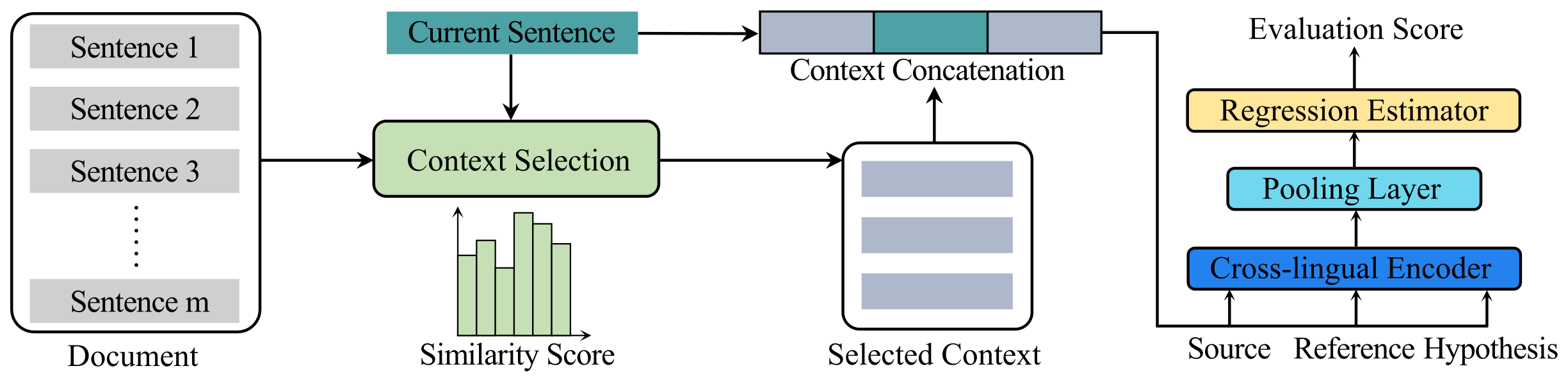
Adding document context to a translation metric only at inference trades sentence-level accuracy for system-level gains. Cont-COMET trains COMET with selected context, as human annotators see it, and largely removes that trade-off.
- Result
- WMT22 segment-level Kendall τ with MQM judgments: Cont-COMET 0.354 vs 0.349 for COMET-21 and 0.292 when COMET-21 gets six context sentences at inference only.
- New vs prior
- Vernikos et al. (2022) add preceding sentences to a pretrained metric only when scoring, which performed poorly at segment level; Cont-COMET trains COMET with selected preceding and following context.
- Limitation
- On WMT21 News, every Cont-COMET variant's segment-level τ (0.303–0.306) stays below COMET-21's 0.311, and at WMT22 system level inference-only context scores higher (0.952 vs 0.943).
A sentence can be fluent and still be the wrong translation
Surrounding sentences can decide whom a pronoun refers to, or whether “They returned to the bank” means a riverbank or a financial institution. WMT human annotators have rated translations with document context since 2019, yet most metrics still score one sentence at a time, without the evidence the annotators had.
Adding context only at inference is not enough: a metric trained on single sentences has not learned to separate a good surrounding passage from a bad target sentence, so a prepended paragraph shifts its input and can blur the judgment. Cont-COMET selects relevant context and trains with it.
Closest prior work
Neural metrics such as COMET (Rei et al., 2020) score each sentence from its source, reference, and hypothesis, although WMT human annotation has included document context since 2019. Vernikos et al. (2022) encoded preceding sentences when computing scores and concluded that two preceding sentences work best; the paper argues that this conclusion was not tested thoroughly and notes the approach's poor segment-level correlation. Cont-COMET uses both preceding and following context, selects it by relevance, and trains the metric with it.
Context-aware training, not context alone, protects sentence-level scores
0.354
WMT22 segment-level Kendall τ
Cont-COMET with six selected context sentences, versus 0.349 for COMET-21 and 0.292 for COMET-21 given three preceding and three following sentences at inference only (Table 2).
0.296
Context at test, not in training
A metric trained without context but given the same six-sentence context at test reaches WMT22 segment τ 0.296, versus 0.354 when trained with context (Table 3).
The informative comparison is with COMET-21 given the same six context sentences without retraining. On WMT22 that inference-only variant ranks systems best but has the lowest segment-level correlation, while the trained metric gives up a little system-level correlation for the highest segment τ (Table 2). On WMT21 News, inference-only context lowers both levels; Cont-COMET restores system correlation, but its segment τ stays slightly below COMET-21's.
In Table 3, removing selection changes WMT22 correlations only from 0.943 to 0.942 (system) and from 0.354 to 0.353 (segment). Training without context but testing with it reproduces the inference-only pattern, and training with preceding sentences alone is worse on every reported measure. Training under the conditions of use carries the gain; selection is a small refinement.
Table 2 (selected columns). System-level Pearson correlation (Sys.Cor) and segment-level Kendall τ (Seg.Cor) with MQM human judgments, averaged over en-de, en-ru and zh-en; higher is better. “+ 3 prev & 3 next sentences” adds context to COMET-21 at inference only, without training; the WMT21.TED and system-level pairwise-accuracy columns are omitted. Source ↗
| Model | WMT21.News Sys.Cor | WMT21.News Seg.Cor | WMT22 Sys.Cor | WMT22 Seg.Cor |
|---|---|---|---|---|
| COMET-21 | 0.661 | 0.311 | 0.910 | 0.349 |
| + 3 prev & 3 next sentences | 0.645 | 0.249 | 0.952 | 0.292 |
| Cont-COMET: 2 context sentences selection | 0.664 | 0.306 | 0.938 | 0.353 |
| Cont-COMET: 4 context sentences selection | 0.663 | 0.306 | 0.941 | 0.353 |
| Cont-COMET: 6 context sentences selection | 0.665 | 0.303 | 0.943 | 0.354 |
| Cont-COMET: 8 context sentences selection | 0.664 | 0.303 | 0.943 | 0.354 |
Method proposed in the paper
Scope. Evaluation covers three language pairs (en-de, en-ru, zh-en) on the WMT21 TED, WMT21 News, and WMT22 test sets. The paper notes that context-annotated training data remain scarce and that the 512-token encoder limit prevents encoding whole documents. Read the study ↗
Read the abstract
Previous studies on machine translation evaluation mostly focused on the quality of individual sentences, while overlooking the important role of contextual information. Although WMT Metrics Shared Tasks have introduced context content into the human annotations of translation evaluation since 2019, the relevant metrics and methods still did not take advantage of the corresponding context. In this paper, we propose a context-aware machine translation evaluation metric called Cont-COMET, built upon the effective COMET framework. Our approach simultaneously considers the preceding and subsequent contexts of the sentence to be evaluated and trains our metric to be aligned with the setting during human annotation. We also introduce a content selection method to extract and utilize the most relevant information. The experiments and evaluation of Cont-COMET on the official test framework from WMT show improvements in both system-level and segment-level assessments.
Full paper ↗Citation BibTeX
@inproceedings{hu-etal-2023-exploring,
    title = "Exploring Context-Aware Evaluation Metrics for Machine Translation",
    author = "Hu, Xinyu  and
      Yin, Xunjian  and
      Wan, Xiaojun",
    booktitle = "Findings of the Association for Computational Linguistics: EMNLP 2023",
    month = dec,
    year = "2023",
    address = "Singapore",
    publisher = "Association for Computational Linguistics",
    url = "https://aclanthology.org/2023.findings-emnlp.1021/",
    doi = "10.18653/v1/2023.findings-emnlp.1021",
    pages = "15291--15298"
}