EMNLP 2023Learning from new knowledge
ALCUNA: Large Language Models Meet New Knowledge
ALCUNA creates fictional organisms to test knowledge that models have not memorized, exposing a gap between reading new facts and connecting them to existing knowledge.
- Result
- ChatGPT, the strongest tested model, scores 75.44% on knowledge understanding but 41.52% on knowledge association (few-shot vanilla); all four models score lowest on association there.
- New vs prior
- Temporal benchmarks such as TemporalWiki must be recollected and may leak into training data, and entity substitution (Longpre et al., 2022) builds contradicting statements; this work generates ontology-consistent artificial entities.
- Limitation
- KnowGen is implemented only on biological taxonomy data, and only four 2023 models (ChatGPT, Alpaca-7B, Vicuna-13B, ChatGLM-6B) are evaluated.
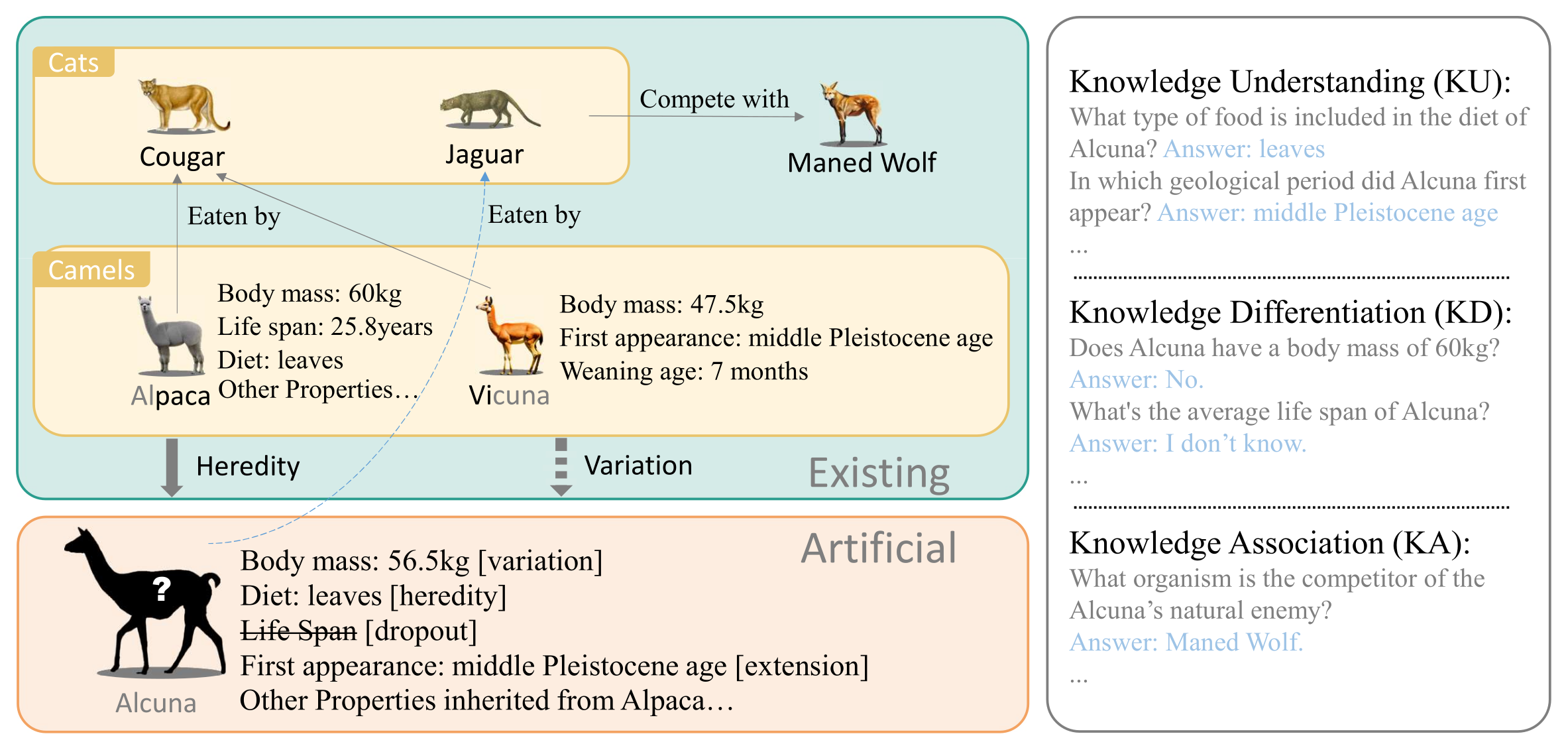
Artificial entities make novelty verifiable
A correct answer about a new entity may come from memorization, from the supplied description, or from a guess prompted by a familiar name. ALCUNA controls for memorization by construction: its generator, KnowGen, creates artificial organisms by transforming entities in the Encyclopedia of Life (EOL) taxonomy, so every property traces back to a known operation.
Properties shared by the class are kept while selected attributes and relations change, so the questions stay biologically meaningful. This is a harder test than an arbitrary name with unrelated facts: the new entity resembles one the model already knows, so familiar knowledge can support reasoning or interfere with the new description.
Closest prior work
Earlier evaluations obtain new knowledge from temporal change, as in TemporalWiki (Jang et al., 2023) and Lazaridou et al. (2021); the paper notes that such data must be recollected for each new model, may already be in undisclosed training data, and differs across models with different cutoffs. Entity-substitution methods (Longpre et al., 2022; Zhou et al., 2023) replace an entity name in a short statement to create knowledge that contradicts the model. KnowGen instead builds a complete artificial entity in ontological form, through heredity, variation, extension, and dropout, so the new knowledge stays consistent with, and connected to, existing knowledge.
The bottleneck is linking new to existing knowledge
75.44 vs 41.52
ChatGPT: understanding vs association (%)
Few-shot vanilla accuracy. The strongest model reads the new entity's description well but struggles to connect it to knowledge it already has.
27.47 → 44.43
ChatGLM association with chain entities (%)
Adding the entities on the reasoning chain to the context raises association; the same number of irrelevant entities lowers it to 18.56.
The context ablations show why separate ability scores matter. Supplying the chain entities raises association for all three open models, so the main problem is linking new and existing knowledge, not only multi-hop reasoning. Adding the parent entity instead lowers Vicuna's differentiation from 46.76 to 35.04: related context can supply a missing link or strengthen the wrong association.
Presentation also matters. All three open models score higher when the new entity is given as structured JSON than as natural-language text; ChatGLM's average falls to 20.54 with natural language. Success therefore depends partly on how new knowledge is communicated.
Table 1 (Few-Shot-Vanilla setting only; transposed so models are rows). Answer-match accuracy on ALCUNA questions, higher is better; KU = knowledge understanding, KD = knowledge differentiation, KA = knowledge association; Avg. is the paper's overall score on the whole benchmark, not the mean of the three columns. Alpaca-7B, Vicuna-13B, ChatGLM-6B. Questions are filtered so that the relevant existing entities are recalled by the evaluated models, and the intersection of the filtered sets is used. Source ↗
| Model | KU | KD | KA | Avg. |
|---|---|---|---|---|
| ChatGPT | 75.44 | 64.20 | 41.52 | 64.37 |
| Alpaca | 33.80 | 38.97 | 27.63 | 35.09 |
| Vicuna | 41.22 | 46.76 | 30.10 | 42.74 |
| ChatGLM | 47.97 | 41.42 | 27.47 | 42.56 |
Scope. The benchmark uses synthetic biological entities and the models evaluated in 2023. Freshly generated entities reduce memorization concerns; publishing a fixed dataset does not guarantee permanent freedom from contamination. Read the study ↗
Read the abstract
With the rapid development of NLP, large-scale language models (LLMs) excel in various tasks across multiple domains now. However, existing benchmarks may not adequately measure these models’ capabilities, especially when faced with new knowledge. In this paper, we address the lack of benchmarks to evaluate LLMs’ ability to handle new knowledge, an important and challenging aspect in the rapidly evolving world. We propose an approach called KnowGen that generates new knowledge by altering existing entity attributes and relationships, resulting in artificial entities that are distinct from real-world entities. With KnowGen, we introduce a benchmark named ALCUNA to assess LLMs’ abilities in knowledge understanding, differentiation, and association. We benchmark several LLMs, reveals that their performance in face of new knowledge is not satisfactory, particularly in reasoning between new and internal knowledge. We also explore the impact of entity similarity on the model’s understanding of entity knowledge and the influence of contextual entities. We appeal to the need for caution when using LLMs in new scenarios or with new knowledge, and hope that our benchmarks can help drive the development of LLMs in face of new knowledge.
Full paper ↗Citation BibTeX
@inproceedings{yin-etal-2023-alcuna,
    title = "{ALCUNA}: Large Language Models Meet New Knowledge",
    author = "Yin, Xunjian and Huang, Baizhou and Wan, Xiaojun",
    booktitle = "Proceedings of the 2023 Conference on Empirical Methods in Natural Language Processing",
    year = "2023",
    url = "https://aclanthology.org/2023.emnlp-main.87/",
    pages = "1397--1414"
}